Showing posts with label Beatles. Show all posts

Thursday, August 09, 2012

George Harrison by Scorsese


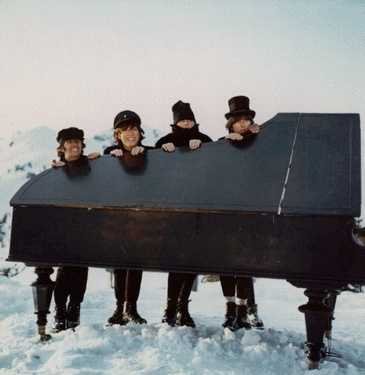
Seen last year on pay cable, George Harrison Living in the Material World, a film directed by Martin Scorsese is now widely available on DVD. It’s a two disk set divided into the two parts seen successively on HBO for a total of 229 minutes.  There are a few extra scenes and interview snippets as special features, which are nice but not much. I especially felt the absence of some full song performances as were included in the DVD of Scorsese’s film on Bob Dylan. His music grows more impressive with time. [The image above begins and ends this film.]


Some of the footage has been used elsewhere but there’s a lot that comes from Harrison’s “home movies” and photos. There are archival soundbites with Harrison, and new interviews with George’s wife Olivia Harrison (a co-producer) and his son Dhani, and with Paul McCartney, Ringo Starr, Yoko Ono, Eric Clapton and other friends, including the race car driver Jackie Stewart.

Scorsese makes some strange cuts and a few significant omissions, but the major biographical elements are there: the Beatles and post-Beatles music, Harrison’s spiritual journey, his invention of the all-star benefit with the Concert for Bangla Desh, and his involvement in film (he mortgaged his house to finance Monty Python’s The Life of Brian.) It’s a rounded if impressionistic portrait. While interviewees speak of the necessarily intense bond among the Beatles, Scorsese shows images of hysterical fans and the rest of the crazed context. Eric Clapton recalls how magical they were as a group, even moving in ways special to themselves.


[Photo above: Olivia Harrison with director Martin Scorsese] On second viewing, some of the rhyming scenes emerge: for instance, early in the film, Dahni relates a recent dream in which he asks his father where’s he’s been and George replies, “I’ve been here all the time.” Much later, Tom Petty describes a phone conversation the day after Roy Orbison’s death (he, Orbison, Harrison plus Bob Dylan and Jeff Lyne were then recording as the Traveling Wilburys) in which Harrison said, “he’s still around."

Death was a focus of Harrison’s spiritual attention, but he did have 58 years of life before cancer took him in 2001 (as opposed to John Lennon, who was shot to death before his 40th birthday.)  The last part of his mature life is especially rich territory for Scorcese, highlighted by Olivia Harrison’s wise and beautiful description of the mutual lessons of their marriage. The film gently considers his wilder and darker moments as well as his spirituality and wit. Several interviewees describe Harrison as having two distinct sides: calm and kind, or angry and acerbic. When he was with the Beatles he yearned to be on his own, and later (someone observes) he missed being in a band. He craved solitude and peace, but had several circles of friends and seems to have had a special talent for friendship.

His humor was also an evident trait, one which rates at most memorable to Paul McCartney.  Olivia describes in detail the horrific attack that injured both she and George, who was stabbed.  But as he was being taken away on a stretcher, he noticed a workman who had just that day joined the crew helping him with landscaping.  George said to him, "So how do you like the job so far?"

Two other moments stand out in this companionable film. After John Lennon’s death, a reporter observed to George that Lennon “was no angel.” “No, he wasn’t,” Harrison said, “but he was, as well.” “Was he?” “Yeah.”

 Ringo recalls visiting Harrison during his final illness, when he was too weak to get out of bed. Ringo told him he had to leave to visit his daughter in Boston who had a brain tumor. The last words Harrison spoke to him were, “Do you want me to go with you?”   


Son Dahni, Olivia and producer George Martin

Olivia, Scorsese and Paul McCartney.

Dhani Harrison.

Tuesday, May 03, 2011

...And Why Is Everybody Talkin' About Him?


Who is Harry Nilsson (And Why Is Everybody Talkin About Him?) is the title of a movie, and now a DVD, by John Scheinfeld. The title is a paradox and a pun. The paradox is that Harry Nilsson is both famous and unknown (as someone says in the film, you either recognize the name right away or you have no idea who he is.) The pun refers to his most famous recording, “Everybody’s Talkin’”, a Grammy winner featured in the classic movie Midnight Cowboy.

Harry Nilsson was a musical force in the early 1970s as a singer and songwriter, though he never quite became a star. But as this DVD demonstrates, he did achieve a mythological status and musical immortality.

At one time or another I owned the first 10 of his 15 albums and I still have four: his first two from the late 60s (which brought him praise from the Beatles), his early 70s multiple-Grammy winner Nilsson Schmilsson and the notorious follow-up Son of Schmilsson. In my rock critic days I'm pretty sure I saw him at a record launch, probably for The Point. Though in the early 70s he was a phenomenon, in the mid-70s he became a notorious co-hellraiser with John Lennon and Ringo Starr. By the time a friend of mine who worked for Robert Altman’s film company played me a cassette of Nilsson’s demos for the 1980 movie Popeye, he was almost forgotten.

Even his career was a paradox. Though he did have hits that he both wrote and sang (“Spaceman,” “Jump Into the Fire,” the novelty classic “Cocoanut”) his biggest songwriting hits were sung by others (“One” by Three Dog Night) and biggest singing hits were written by others (“Everybody’s Talkin,’” “Without You”.)


Abandoned by his father, his mother had a hard time keeping the family together, and young Harry experienced real poverty. As a teen he even resorted to holding up a liquor store so the rent could be paid. By the age of 15, he was out on his own. He made his way to Los Angeles and worked his way up to assistant manager at the Paramount Theatre. When he was first becoming known, the story was simply that he “worked in a bank.” It sounded like he was some polite young teller, but in fact he was the supervisor for a data processing operation with 132 people that handled $200 million of checks a night.

He worked assidiously at making contacts as a songwriter and his talent was recognized early, though it was awhile before he got beyond jingles. His first break was selling a song to the Monkees, then one of the biggest acts in pop music. It was then that his agent told him he could quit the bank.

That first RCA album (Pandemonium Shadow Show) showcased both his songwriting and his singing. Right from the start he applied the multi-tracking techniques of the Beatles to his own voice, and became essentially the first one-person group by pioneering overdubbing. The Beatles publicist Derek Taylor heard one of his songs, bought many copies of his album and took them back to London. Soon Nilsson (he went by the one name) was getting phone calls from each of the Beatles in turn. John told a reporter that Nilsson he was his favorite American singer. Paul told the same reporter that Nilsson was his favorite American group.

His songs were deceptively mild and whimsical. But “1941” was an autobiography of his own abandonment. Still, no one was writing songs like this, and no one was singing like this either. On the DVD another famed singer and songwriter of the period, Jimmy Webb, calls him “the best singer of our generation.”

His second album Aerial Ballet contained two hits—his breakout “Everybody’s Talkin” (which didn’t become really big until Midnight Cowboy) and “One (is the loneliest number)”—a song inspired by the fatal monotone of a telephone busy signal—which became a hit for Three Dog Night.

Nilsson didn’t tour, and very seldom performed at all. His next albums were equally quixotic: the soundtrack to a children’s animated film he also wrote (The Point) and an album entirely of someone else’s songs—the then-unknown Randy Newman.

But he seemed to get back on the fast track again when he hooked up with producer Richard Perry. Their ambition was to create an album as good as the Beatles, and Perry would be his George Martin. Nilsson Schmilsson pretty much fulfilled that promise. It even had a big hit (“Without You”) written and recorded by Badfinger, a group nurtured by the Beatles ( and produced by George Harrison) who recorded for Apple. The album won several Grammys.

But his private life was troubled. A Catholic, he was torn up by his divorce, and found himself horrifically replicating his own childhood by leaving behind his young son. He was also a carouser who loved to involve his musician and show biz friends in epic benders. “He went 500 miles an hour,” said the Monkees Micky Dolenz, “till he stopped.”

His next album—Son of Schmilsson—was harder, edgier, and producer Perry didn’t like it. It ended their professional relationship. Then came the then-notorious hell-raising with Lennon (on the loose after splitting with Yoko, before they reunited) and Ringo. But in all this chaos, Harry walked into an ice cream parlor and fell in love. Strangely, she was the love of his life. They married happily and had six children.

After “Son of,” Nilsson took another unconventional turn and became probably the first rock singer to record standards of the 40s and 50s, which he did with conductor Gordon Jenkins. Even more than The Point, this was supposed to be evidence of his craziness. But it remains one of his most enduring recordings. He said that he was convinced that his voice was at a perfect point for him to do these songs, and listening to them it’s hard to argue.

Especially since he soon damaged that voice, partly through smoking and drinking, but also in trying to compete with Lennon in his scream therapy phase, leading to the uneven album Lennon produced, Pussy Cats.

When Lennon was murdered in 1980, Nilsson devoted himself to advocating for gun control. He continued to write and record, working on “Popeye” and other movie projects, and making more friends—many of whom are interviewed for this DVD, including Robin Williams, Terry Gilliam and Eric Idle.

There was more drama to come, including near-bankruptcy when a manager stole virtually every penny he had. But he returned his family to financial security before he died of heart failure in 1993. He was only 52.


The great virtue of this DVD—for people who don’t know who Nilsson was, as well as Boomers who do—is the gorgeous music it presents. Just enough to interest anyone in this man’s story. (Apparently there was an earlier version of this film, expanded when more archival footage was found.)

The movie gives Nilsson’s life a particular storyline, in what it includes and how it arranges it, and what segments of what interviews it provides. It’s not entirely limiting—there’s so much to ponder that viewers can follow their own alternate storylines.

But even better, there are more interviews and more from the interviews as DVD extras. There we hear more about Nilsson’s nobility of spirit—how he helped many people financially, with little prompting. We also get some alternate takes on things.

For example, the director Scheinfeld seems to take his cue from Richard Perry when he castigates Nilsson’s “Son of Schmilson” songs as so counter-commercial as to constitute a “death-wish.” Perry had expected “a lifetime of hits” from their continuing collaboration, but is particularly sarcastic about the abrasive and offensive to the pop audience lyrics of “You’re Breaking My Heart” (“you’re tearing it apart/so fuck you...”)

But in an extra interview it’s mentioned that at Nilsson’s graveside, George Harrison said that this was his favorite Nilsson song. And so Harrison led several of the superstars in attendance in singing Nilsson to his rest with his words, “You’re breaking my heart/you’re tearing it apart/so fuck you.”

It was always one of my favorites. Harry Nilsson, his first wife said, had trouble expressing anger (which is why, she thought, he gravitated to John Lennon, who had no such trouble.) When he finally did get anger and pain into the forefront of his music, his producer turned against him. But it was authentic. No doubt he made mistakes of excess. But his artistic decisions were usually exactly right, as his recorded legacy affirms.

After seeing this DVD I think of another of his songs, and the lyric “You can jump into the fire/but you can never be free.”

Saturday, October 09, 2010

Happy Birthday, John Lennon


John Lennon would have turned 70 today. For a reminiscence, see this post at 60's Now. Click collage to enlarge.

Sunday, October 19, 2008

Across the Universe


The best movie about the 60s made since the 60s so far is Julie Taymor's Across the Universe, which tells its story with songs composed by the Beatles.

The Best 60s Movie Yet

It's been out for awhile, but after seeing it for the third time I'm ready to pronounce Across the Universe as the best movie about the 60s made since the 60s.

This movie that tells a very 60s story mostly with Beatles songs has all the hallmarks of its director, Julie Taymor: the masks, the hints of Balinese dancing and whirling dervishes, the vivid and colorful imagination and surprising stylized sequences together with realism. But with an ingenious story and script by Ian La Frenais (who I remember as the first writer of the Lovejoy series from the BBC, which by coincidence I'm currently watching again on DVD), it depicts the 60s as I remember them, especially emotionally. There may be a few instances of incorrect chronology, but truly there are no false notes.

Using brilliant unknowns as stars, and pretty much hiding stars in musical performances, the story of a boy from Liverpool named Jude and his romance with an American girl named Lucy covers so much and so many characters that ring true. The dinner table debates with parents, the idiotic measures friends advised to flunk the draft physical--it's all exactly right.

So is the clash between a politically radicalized Lucy and the artistic Jude, whose drawings even resemble John Lennon's. The movie plays with 60s myth as well as realities, imagining what might have happened if Janis Joplin had hooked up with Jimi Hendrix. Or the clash of psychedelic egos when a Ken Kesey type is dissed by the Tim Leary figure, as West Coast fails to meet East. (There's even a brief shot on Kesey's bus of a guy typing madly--a Tom Wolfe joke?)

Sure, it's a romance, so instead of dying young from overdoses, the Janis and Jimi figures find true love in each other, and after Jude gets girl, and Jude loses girl, Jude and Lucy seem to reunite. And the LSD episodes are playful and magical and innocent--but the truth is that for a lot of us, it all was pretty innocent. At first anyway. The draft physical sequence may be overstylized to make a familiar point, but it does suggest how helpless and strange the experience was, and the Vietnam sequences have that Apocalypse Now surreal tinge that vets suggest was very real.

And sure, there's a lot left out (my beef with these stories about anti-war awakenings is that people are never seen reading, which is mostly how we learned this stuff. Not very cinematic I guess, unless you're French New Wave--they could show people reading as a dramatic act.) But it's stripped down to myth, and this myth represents the reality. If you weren't there and you want to know what the 60s were like, this gives you a pretty good idea.

At the same time it's also wish fulfillment--that is it fulfills our fondest wish of life as a series of Beatles songs. So that's a pretty satisfying way of identifying with this.

For serious Beatles fans, it's got endless layers. The music is done very well, first of all. By now that music has been absorbed into the cultural and musical bloodstream. But there are lots of wonderful references, right down to shots that homage Beatles videos and movies, A Hard Day's Night, Yellow Submarine and the last Beatles concert, on the rooftop in Let It Be. Early in the film there's a "With a Little Help From My Friends" sequence that veers from a fairly straightforward Sergeant Pepper's cover to referencing the Joe Cocker version. What ever happened to Joe Cocker? you're wondering. Well, in a few minutes, there he is, the real Joe Cocker: probably as you figured he'd end up, as a bum singing in the subway tunnel, and looking comfortable doing it.

Anyway, if you haven't seen it, do. It's long but there isn't a second wasted. The "Dear Prudence" sequence alone will knock you out, and the whole movie gets better with repeated viewings. It's visually brilliant, eclectic without being overbearing. (The 60s themselves mashed artistic and historical styles, with a lot more meaning, sincerity and glee than subsequent glib or grim postmodernism.) The casting is brilliant--you'll feel through these actors. Across the Universe is a boomer classic.

Monday, May 22, 2006


Beatles "Ticket to Ride" sequence in 1965 film, "Help!" Posted by Picasa